Unistrut Channel Systems: A Comprehensive Guide
In commercial construction, industrial manufacturing, and mechanical trades, few components are as ubiquitous or versatile as unistrut. Often referred to generically as strut channel or metal framing channel, this modular support system functions essentially as heavy-duty structural Lego for engineers, electricians, and pipefitters. Invented in the 1920s by Charles Attwood, the system eliminated the need for specialized welding and drilling on job sites, providing an adjustable, reusable framework capable of supporting immense static and dynamic loads.

Whether you are designing an overhead trapeze system for conduit, building seismic restraints for HVAC ductwork, or fabricating custom shop shelving, understanding how to select the right channel, finish, and hardware is essential for safety and structural integrity.
What Is Unistrut and How Does It Work?
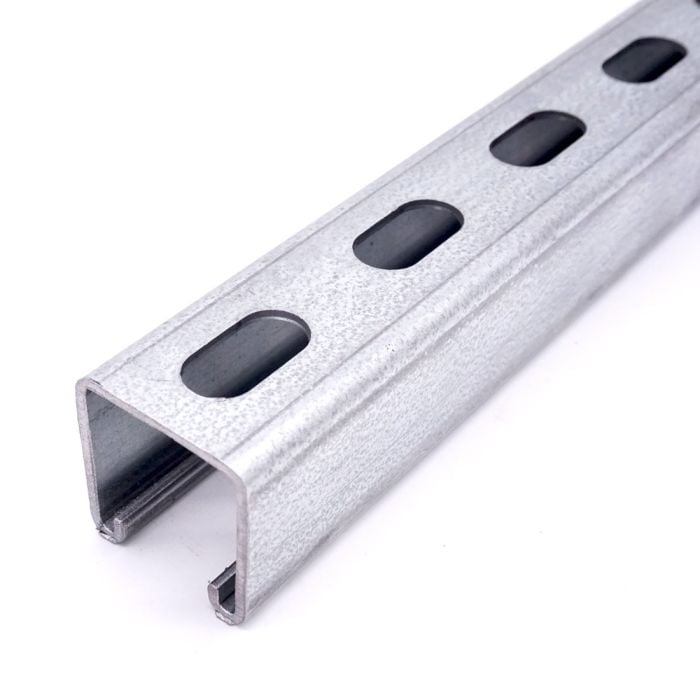
At its core, a strut channel is a roll-formed metal track with inward-curving lips along its open side. These lips act as locking shoulders for specialized hardware known as channel nuts (or spring nuts). A channel nut has serrated grooves on one face that bite directly into the folded lips of the channel when a bolt is tightened down through a bracket or plate.
This simple friction-and-groove mechanical bond creates a rigid connection that can withstand significant shear and pull-out forces without slipping. If changes are required later, a technician simply loosens the bolt, slides the component to a new location, and retightens it. No torch cutting, grinding, or structural welding is necessary.
Common Types and Profiles of Unistrut
Strut channels come in several standardized cross-sectional dimensions, wall thicknesses (gauges), and perforation patterns. The exterior width is almost universally 1-5/8 inches (41.3 mm), but the channel depth varies according to the required load capacity and clearance constraints.
1. Standard / Deep Channel (1-5/8" × 1-5/8")
Often designated as P1000 in manufacturer catalogs, this is the industry baseline. Typically cold-formed from 12-gauge steel, deep channel offers high beam strength and resistance to deflection over moderate spans. It is the default choice for pipe racks, electrical feeder conduits, and industrial equipment frames.
2. Shallow Channel (1-5/8" × 13/16")
Frequently designated as P3300 or P4000 depending on the steel gauge (usually 12, 14, or 16-gauge), shallow channel is half the height of standard channel. It is used when vertical clearance is tight, such as mounting directly against concrete ceilings or within drop-ceiling plenums, or when the supported load is light (e.g., small junction boxes, branch wiring runs).
3. Combination / Back-to-Back Channel
For high-load applications where deflection must be minimized over long spans, channels are factory-welded spine-to-spine (creating a 1-5/8" × 3-1/4" profile) or in various modular configurations. Double channels significantly increase the section modulus, allowing for fewer ceiling drops and wider support spacing.
4. Hole Patterns: Solid vs. Slotted
Video: how to install frame with unistrut for solar panel

- Solid Channel: Contains no pre-drilled holes. It provides maximum torsional rigidity and load capacity. Fasteners must be mounted to the open face, or custom holes must be drilled through the back.
- Slotted Channel: Features oval slots (typically 9/16" × 1-1/8" spaced on 2-inch centers) along the back spine. This allows for quick anchoring to threaded rods, concrete anchors, or structural steel without on-site drilling.
- Half-Slot Channel: Features smaller slots (typically 9/16" × 7/8"), offering a balance between mounting adjustability and web strength.
Materials and Corrosion-Resistant Finishes
Choosing the correct finish is critical to preventing galvanic reactions and environmental corrosion. Using standard indoor-rated channel outdoors can lead to premature failure within months.
- Pre-Galvanized (Mill Galv): Steel is zinc-coated prior to roll forming. It is suitable strictly for clean, dry indoor environments like commercial drop ceilings or utility rooms. Cut ends expose raw steel and must be sealed with cold-galvanizing compound.
- Hot-Dip Galvanized (HDG): The entire channel is dipped into molten zinc after fabrication, fully coating the edges, cutouts, and welds (compliant with ASTM A123). This is the standard for outdoor installations, chemical plants, wastewater facilities, and exposed roofs.
- Stainless Steel (Types 304 and 316): Impervious to extreme atmospheric and chemical corrosion, stainless channel is required in food and beverage processing, marine applications, and pharmaceutical washdown areas.
- Fiberglass (FRP): Non-conductive and highly resistant to aggressive acid vapors, fiberglass strut is standard in battery rooms, plating facilities, and high-voltage electrical substations.
- Powder Coated / Painted: Available in green or custom safety colors, often used for architectural visibility or color-coded plant services.
The Hardware Ecosystem: Bringing the System Together
A strut channel is only as capable as the fittings attached to it. The system relies on a standardized accessory catalog designed to solve nearly any framing challenge.
Channel Nuts (Spring Nuts)
The core fastener of the system. Nuts are available without springs, with short springs (for shallow channel), and with long springs (for standard channel). The spring holds the nut securely in place against the internal channel lips while an installer inserts and tightens the bolt. Sizes range from #10 screws up to 7/8-inch bolts, with 3/8-inch and 1/2-inch being the standard for mechanical trades.
Fittings and Brackets
Hot-rolled steel flat plates, 90-degree angle brackets, tee plates, cross plates, and gusseted brackets bolt directly to the open face or slotted back of the channel. These fittings allow installers to create three-dimensional structures, cantilevered arms, and rigid wall standoffs without specialized metal fabrication.
Pipe and Conduit Clamps
Strut-mounted clamps snap or slide into the channel to grip EMT, rigid conduit, copper tubing, or PVC pipe. For copper lines, dielectric insulation or thermoplastic cushions are inserted between the pipe and the clamp to prevent dissimilar-metal corrosion.
Installation Best Practices and Structural Rules
While strut systems are forgiving and reconfigurable, structural integrity depends on proper mechanical execution:
- Consult Manufacturer Load Tables: Never guess beam deflection. Channel manufacturers publish comprehensive tables showing allowable uniform beam loads and column loads based on support span distances. If a span exceeds 6 to 8 feet, you may need a deeper profile or back-to-back channel.
- Cut Square and Deburr: Always cut channel with a cold-cut chop saw, horizontal band saw, or hydraulic strut cutter. Avoid abrasive chop saws where possible, as excessive heat can scorch protective zinc coatings. Always deburr cut edges using a flat metal file to protect cables and hands.
- Adhere to Torque Specifications: A connection relies on friction. Under-torquing can cause brackets to slip under dynamic loads, while over-torquing can strip the bolt or damage the channel lips. A standard 1/2-inch grade 2 strut bolt requires approximately 50 ft-lbs of torque.
- Plan for Thermal Expansion: Long runs of pipe or solar arrays mounted on strut channels will expand and contract with temperature shifts. Use slotted slide-guides or roller supports rather than rigid clamps when dealing with long, unanchored thermal runs.
Summary
The enduring popularity of the strut channel system lies in its balance of raw strength and modular simplicity. By matching the right channel depth, hole configuration, and corrosion protection to your environment, you create an adaptable support framework that meets rigorous building codes and stands up to decades of service.