Unlock Secret to Easy Dividing Decimals Everyday
Few arithmetic tasks trigger anxiety quite like seeing a pair of numbers separated by decimal points under a division bracket. Whether calculating cost per ounce at the grocery store, splitting a dinner tab among friends, or computing fuel efficiency, decimals appear constantly in modern life. The good news is that decimal division is not fundamentally different from the standard division you learned in elementary school. Once you understand the shifting technique, you can unlock secret to easy dividing decimals everyday without relying on a smartphone calculator every time.

The Fundamental Rule: Why Decimals Confuse Us
Before jumping into shortcuts, it helps to understand why decimal division feels unintuitive. Humans naturally conceptualize dividing whole objects: distributing 12 apples among 3 people makes immediate visual sense. However, dividing 14.4 meters of wire into segments measuring 0.6 meters each feels abstract.
The entire “secret” to mastering decimal division rests on one mathematical property of fractions and ratios: equivalence. A division problem is simply a fraction:
Dividend ÷ Divisor = Dividend / Divisor
As long as you multiply both the dividend (the number being divided) and the divisor (the number you are dividing by) by the exact same value, the final answer remains unchanged. This single principle eliminates the complexity of decimal points entirely.
How to Unlock Secret to Easy Dividing Decimals Everyday
The fastest, most reliable method to solve any decimal division problem involves converting the divisor into a comfortable whole number. Here is the four-step framework you can apply anywhere.
- Identify the divisor's decimal places: Look at the number doing the dividing (outside the bracket). Count how many places the decimal must move to the right to turn it into an integer.
- Shift the dividend equally: Shift the decimal point in the dividend (inside the bracket) to the right by that exact same number of places. If the dividend runs out of numbers, fill the remaining spaces with zeroes.
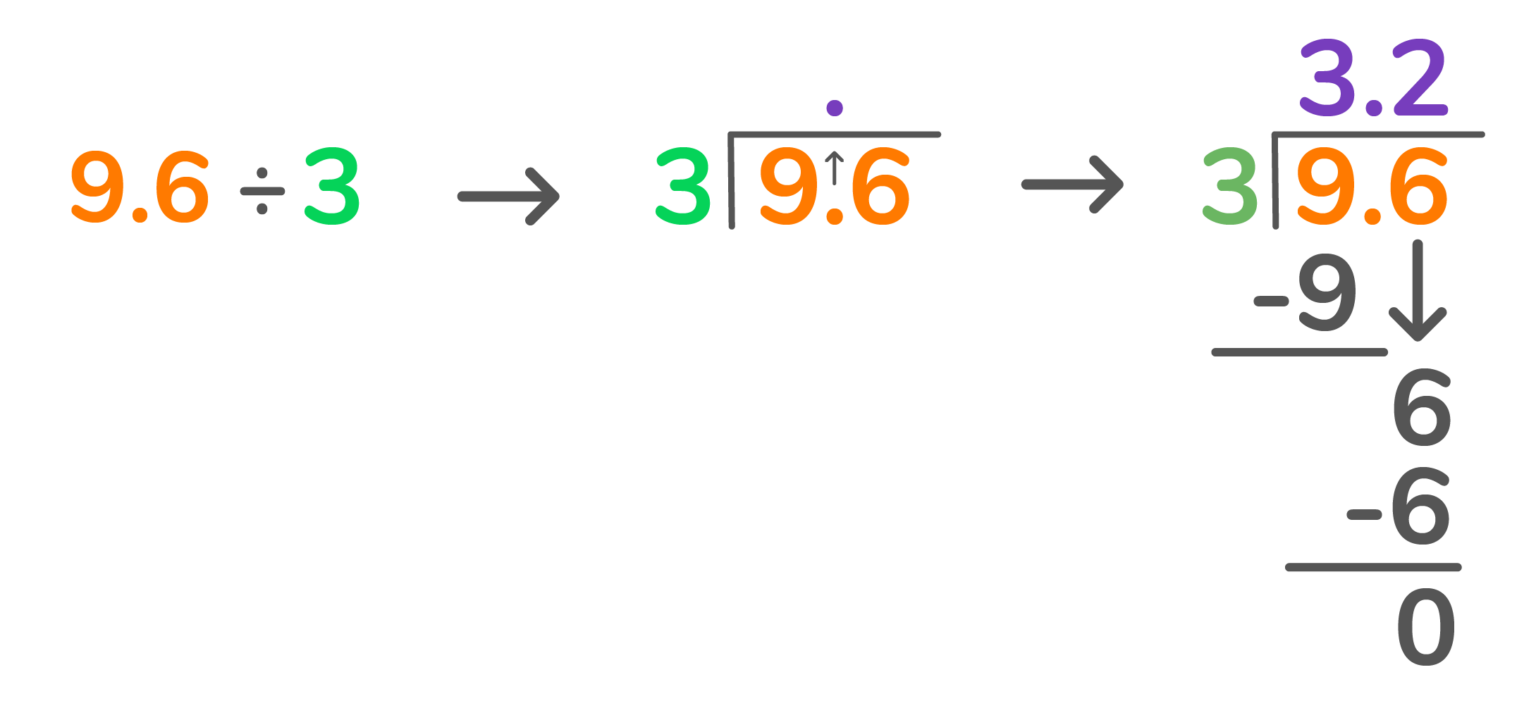
- Place the decimal in the answer line: Draw your division bar and place the decimal point directly above its new position in the dividend. Once placed, you can completely ignore it during the calculation.
- Divide as usual: Carry out standard long or short division using whole-number techniques.
Example 1: Dividing a Decimal by a Decimal
Suppose you need to solve 13.75 ÷ 2.5.
- The divisor is
2.5. Moving the decimal point one place to the right turns it into25. - Move the decimal in the dividend (
13.75) one place to the right as well. It becomes137.5. - Your new problem is 137.5 ÷ 25.
- Place the decimal directly above the space between the 7 and the 5 on your quotient line.
- 25 goes into 137 five times (with a remainder of 12). Bring down the 5 to make 125. 25 goes into 125 exactly five times.
- The result is 5.5.
Example 2: Adding Trailing Zeroes
What happens when the divisor has more decimal places than the dividend? Consider 9 ÷ 0.15.
- The divisor is
0.15, requiring two shifts to become15. - The dividend is the whole number
9(or9.00). Shifting two places to the right turns it into900. - Now calculate 900 ÷ 15.
- 15 goes into 90 six times (6 × 15 = 90), leaving 0. Bring down the final zero to get
60. - Therefore, 9 ÷ 0.15 = 60.
Real-Life Mental Math Shortcuts

You rarely carry scratch paper when buying groceries or dining out. For everyday numbers, specific mental math shortcuts can yield the exact answer in seconds.
1. The Inverse Decimal Multipliers
Dividing by specific common decimals is identical to multiplying by whole numbers. Memorizing these common conversions simplifies real-world calculations:
- Dividing by 0.5 is the same as multiplying by 2. (e.g., $18 ÷ 0.5 = 18 × 2 = $36)
- Dividing by 0.25 is the same as multiplying by 4. (e.g., $7 ÷ 0.25 = 7 × 4 = $28)
- Dividing by 0.2 is the same as multiplying by 5. (e.g., 12 ÷ 0.2 = 12 × 5 = 60)
- Dividing by 0.1 is the same as multiplying by 10. Simply slide the decimal one spot right.
2. The Benchmark Estimation Technique
Before computing exact figures, always establish an anchor estimate. For example, if you are dividing $49.20 by 6.8, round both figures to familiar numbers: $49 ÷ 7 = 7. Your actual answer should be near 7. If your pen-and-paper calculation yields 0.72 or 72, you immediately know a decimal point shifted incorrectly.
Common Pitfalls and How to Avoid Them
Even confident math students stumble on decimal division due to poor layout habits. Keep these precautions in mind:
Misaligning Columns
Digit misalignment is the leading cause of errors in long division. When digits drift diagonally across lined paper, it is easy to place the decimal point over the wrong digit. To prevent this, write your calculations on graph paper or turn standard lined notebook paper sideways so the vertical lines create strict columns.
Forgetting Trailing Remainder Zeroes
In elementary school, you may have stopped dividing once a remainder appeared (e.g., “5 with a remainder of 3”). With decimals, you continue by appending zeroes to the right side of the dividend until the problem terminates or reveals a repeating pattern. For instance, in dividing 6 by 8, rewrite 6 as 6.00, producing 0.75 cleanly.
Putting It into Practice
Confidence with decimals comes from consistent, low-stakes practice. Next time you compare prices at a store—such as calculating the per-ounce cost of a 14.5-ounce jar priced at $3.19—try the shift method manually before opening your phone app. Move the decimal points, establish a quick estimate, and divide. By treating the decimal shift as a standard habit rather than an obstacle, arithmetic stops being a chore and becomes an effortless daily tool.