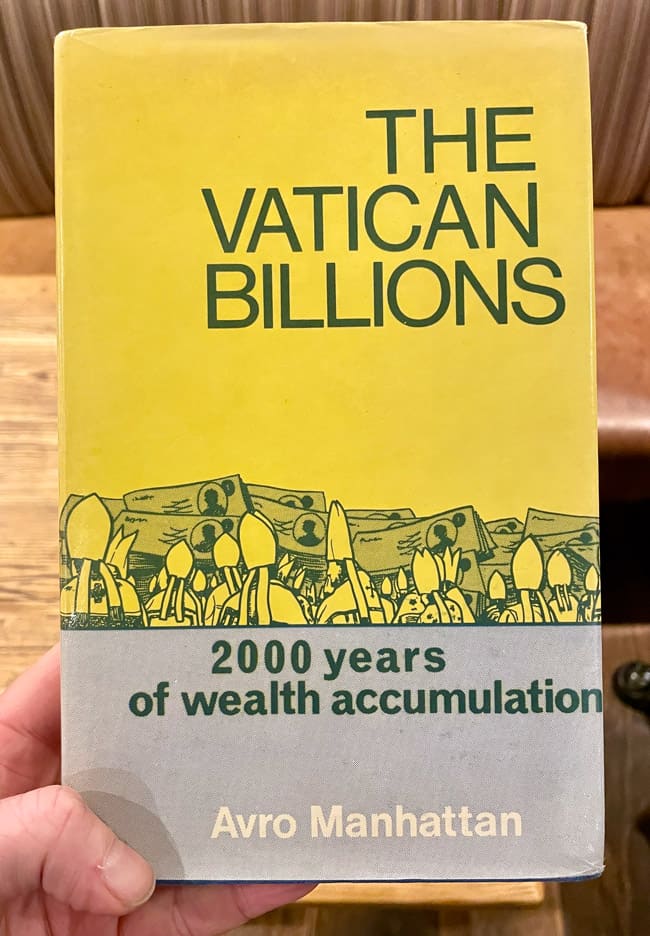
Vatican Wealth Wave: From Millions to $ Billions
For centuries, the financial inner workings of the Roman Catholic Church were shrouded in secrecy, sparking intense speculation about the true scale of its holdings. Tracking the Vatican’s wealth wave: from millions to $ billion trends over centuries provides a fascinating look at how a localized ecclesiastical state transformed into an international sovereign power with an institutional balance sheet spanning global real estate, blue-chip securities, and sovereign reserve funds.
While popular imagination often envisions secret chambers filled with gold bars, the economic reality of the Holy See is grounded in historical realpolitik, strategic treaties, land management, and modern portfolio diversification.
The Feudal Era: Land, Tithes, and Imperial Patronage
During the Middle Ages and Renaissance, the Papacy did not operate as a modern financial investor. Its wealth was tied to land and sovereignty over the Papal States—a vast swath of central Italy stretching from the Tyrrhenian to the Adriatic Sea. Economic power rested on agricultural revenues, customs duties, feudal rents, and compulsory contributions known as Peter's Pence.
Revenue also flowed from religious offices and indulgences, which famously fueled the construction of St. Peter’s Basilica in the 16th century. However, this wealth was largely illiquid and constantly drained by geopolitical conflicts, territorial defenses, and lavish patronages of art and architecture. The collapse of the Papal States during the Italian unification (Risorgimento) in 1870 stripped the Church of roughly 16,000 square kilometers of territory, plunging the Holy See into decades of financial instability.
The 1929 Turning Point: The Lateran Treaty and Bernardino Nogara
The modern era of Vatican finance began not in the Renaissance, but on February 11, 1929, with the signing of the Lateran Treaty between the Holy See and Benito Mussolini’s Italian government. To settle the "Roman Question" and compensate the Papacy for the loss of the Papal States, Italy agreed to provide:
- 750 million Italian lire in immediate cash compensation.
- 1 billion Italian lire in 5% state-backed consolidated bonds.
Valued at approximately $80 million to $100 million at the time (equivalent to well over $1.5 billion in today's currency), this settlement marked the inception of the Vatican's modern investment capital. Pope Pius XI appointed a brilliant, pragmatic layman named Bernardino Nogara to manage the Special Administration of the Holy See.
Nogara set strict operational conditions: he demanded full autonomy to invest outside Italian borders, free from ideological and ecclesiastical constraints. Over the next three decades, Nogara deployed this capital across diversified sectors:
- International Real Estate: Acquiring prime residential and commercial property in Paris, London, and Geneva.
- Corporate Equities: Taking strategic stakes in major industrial, banking, and utility firms, including General Motors, IBM, and Italian conglomerates.
- Gold Reserves: Accumulating bullion deposited directly with the Federal Reserve Bank of New York.
The Anatomy of Modern Holy See Assets
Today, the financial architecture of the Catholic Church is separated into distinct legal and financial entities, which outside observers often confuse.
1. The Administration of the Patrimony of the Apostolic See (APSA)
APSA acts as the central treasury and sovereign wealth manager of the Holy See. Recent transparency reports reveal that APSA directly manages more than 4,000 properties in Italy alone, alongside over 1,100 prime real estate assets across European capitals like London, Paris, and Lausanne. In its audited annual disclosures, APSA reports billions of euros in balance-sheet assets, generating vital operational yield to support the Roman Curia.
2. The Institute for the Works of Religion (IOR)

Commonly referred to as the "Vatican Bank," the IOR is not an investment bank for the public. It serves religious orders, Catholic charities, dioceses, and Holy See employees. The IOR manages roughly €5 billion to €5.5 billion in client assets, focusing primarily on conservative fixed-income securities, sovereign bonds, and cash equivalents.
3. Cultural and Sovereign Assets: The €1 Valuation
It is important to note that the Vatican’s most famous treasures—including the Sistine Chapel, St. Peter’s Basilica, and centuries of irreplaceable historical artifacts—carry an official balance-sheet valuation of exactly €1. Because these cultural heritage assets can never be sold, leveraged, or liquidated, international accounting standards categorize them as inalienable, strictly excluding their priceless nature from commercial net-worth calculations.
The Vatican’s Wealth Wave: From Millions to $ Billion Trends Over Centuries
When analyzing the Vatican’s wealth wave: from millions to $ billion trends over centuries, the progression shifts from territorial taxation to a sophisticated sovereign wealth model. The following milestones highlight this long-term financial evolution:
- 1500s–1700s: Wealth tied to approximately 16,000 square kilometers of agricultural and urban land in Italy, funding architectural marvels alongside costly military defense campaigns.
- 1870: Total territorial loss leaves the Papacy reliant on sporadic international donations and private bequests.
- 1929: The Lateran Treaty establishes modern liquidity, injecting roughly $100 million in combined cash and sovereign debt securities.
- 1930s–1980s: Expansion into international equities, offshore real estate, and financial syndicates, growing institutional assets well into the hundreds of millions.
- 2000s–Present: Comprehensive internal audits, Moneyval compliance, and consolidated reporting place total identifiable assets under Holy See and municipal management in the $4 billion to $10 billion range, excluding unpriced global diocesan holdings.
Financial Scandals, Transparency, and Francis’s Reforms
The accumulation of vast liquid assets was not without governance failures. In past decades, opaque transactions led to high-profile scandals, such as the collapse of Banco Ambrosiano in 1982 and the controversial purchase of a luxury property on Sloane Avenue in London, which resulted in a multi-million-euro loss and a landmark criminal trial in Vatican court.
In response, Pope Francis instituted aggressive structural overhauls:
- Centralizing all investment authority under APSA, stripping the Secretariat of State of independent discretionary funds.
- Aligning the Vatican Bank with international anti-money laundering (AML) standards monitored by the European body Council of Europe (Moneyval).
- Publishing regular consolidated balance sheets to demystify annual deficits and income streams.
The Paradox of Riches: High Assets vs. Operational Deficits
Despite managing billions in gross assets, the Holy See faces persistent structural operating deficits, often running between €30 million and €80 million annually. This paradox stems from the fact that the Roman Curia operates like a multinational government with around 3,000 employees, diplomatic missions worldwide, and global pastoral operations, but with no sovereign tax base.
Operating revenue relies heavily on museum admissions (pre-pandemic generating over €100 million annually), real estate yields, and voluntary Peter’s Pence donations. Furthermore, unfunded pension obligations for aging Vatican personnel represent a major financial challenge requiring long-term fiscal discipline.
Conclusion
The financial history of the Vatican reflects a resilient institutional survival strategy. From the agrarian wealth of the Papal States to the capital injections of the Lateran Treaty and today's institutional portfolio management, the Church has repeatedly adapted its balance sheet to survive changing economic regimes. While modern financial reforms have dispelled myths of boundless liquidity, they confirm that the Vatican remains one of the world's most enduring and uniquely structured sovereign asset holders.