Wallace Nutting Signed Prints: Collector's Guide
In the early decades of the twentieth century, almost every respectable American parlor featured at least one pastoral landscape or colonial hearth scene bearing a neat pencil signature in the lower right margin. Today, wallace nutting signed prints remain one of the most recognizable entry points into early 20th-century American decorative art and the Colonial Revival movement. Yet behind these serene scenes lies a fascinating commercial enterprise, an intricate production system, and a collector's market where values can swing from $20 to several thousand dollars depending on subtle nuances.
What Are Wallace Nutting Signed Prints?
Wallace Nutting (1861–1941) was a retired Congregational minister who turned to photography, antique collecting, and furniture reproduction after stepping down from the pulpit due to poor health. Nutting became an apostle of the Colonial Revival style, arguing that industrialization was corrupting American taste and morality. He sought to reintroduce traditional domestic virtues through his artwork and writing.
Between roughly 1900 and his death in 1941, Nutting created a vast commercial empire. His primary artistic export was the hand-colored photographic print. To create these, black-and-white platinum or silver bromide photographs were printed onto heavy paper, mounted, and then meticulously tinted by hand using watercolor paints. These were not mass-printed mechanical lithographs; each print received individual color work, making no two entirely identical.
The Studio Signature: Did Nutting Sign Every Print?
One of the most common questions new collectors ask is whether Wallace Nutting personally signed every print bearing his name. The short answer is almost certainly no.
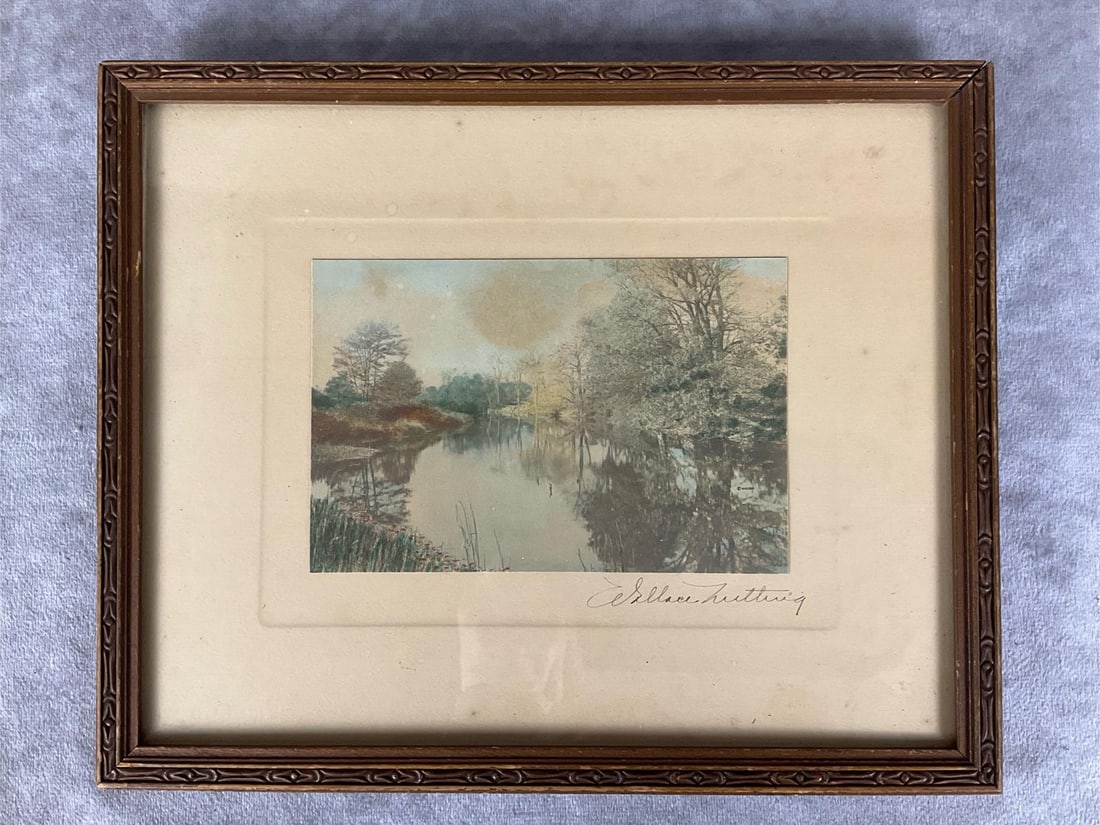
At the peak of his operations at his studio in Southbury, Connecticut, and later his headquarters in Framingham, Massachusetts, Nutting employed a large staff of young women known as "colorists." These artists worked on an assembly-line basis, each specializing in specific elements like foliage, skies, or furniture. As part of their training, head colorists learned to replicate Nutting's distinctive, flourishing signature in soft graphite pencil below the right corner of the image plate.
Nutting himself undoubtedly signed promotional prints, master copies, and gifts for close friends. However, in the antiques trade, a "studio signature" applied by his colorists is recognized as an authentic Wallace Nutting signed print. The presence of a pencil signature—whether executed by Nutting or a trusted studio hand—does not diminish the standard market value of the piece, as this was the recognized studio standard of the era.
Identifying Genuine Prints vs. Competitors and Fakes
Because Nutting was remarkably successful, a slew of contemporaries copied his format. Artists like Fred Thompson, Charles Sawyer, and David Davidson produced very similar hand-colored landscapes and colonial interiors. While collectible in their own right, their values differ from Nutting's catalog.
To confirm you have an authentic Nutting, look for these specific physical hallmarks:
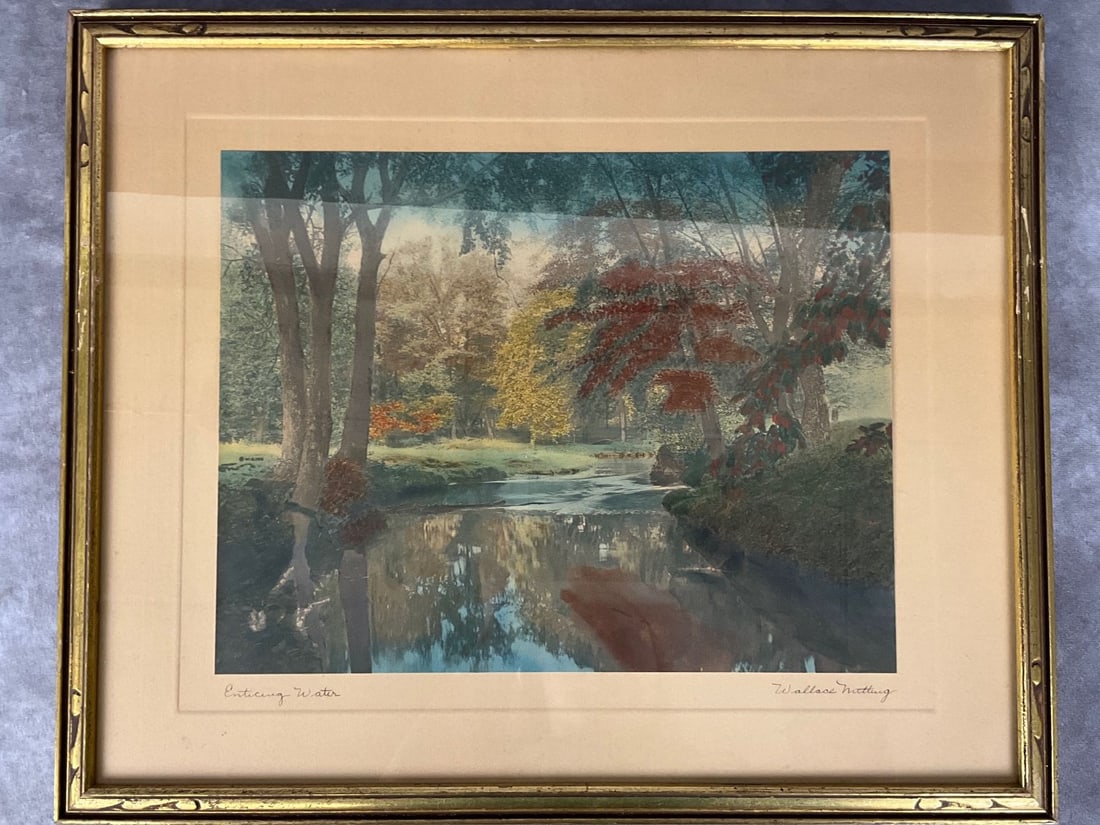
- Pencil Inscriptions: The title of the print is written in pencil at the lower left of the mat or bottom margin, while the signature appears at the lower right. If the signature is printed with ink rather than graphite, it is a modern photomechanical reproduction.
- Paper and Matting: Authentic Nutting prints are mounted on thick, slightly textured cardstock with an embossed or impressed border plate surrounding the image.
- Absence of Halftone Dots: Examine the image under a 10x jeweler's loupe. Real Nutting prints show continuous photographic tone beneath transparent watercolor washes. If you see a grid of tiny ink dots (halftone screen), you are looking at a modern book plate or offset poster.
- Paper Labels and Backings: Most original Nuttings had a paper backing with a printed label. Early labels carried copyright dates and sometimes a brief narrative description of the scene or historic home featured.
Subject Matter: What Drives Market Value?
Video: Michael Ivankovich - Wallace Nutting Furniture

Nutting produced thousands of different titles, but they generally fall into three broad categories. Subject rarity is the single greatest determinant of resale value.
1. Exterior Landscapes and Blossoms (Common)
Scenes depicting apple blossoms, birch-lined country roads, winding brooks, and sheep grazing in pastures were Nutting's bread and butter. Titles like A Barre Brook, Larkspur, and Apple Blossom Time sold in the hundreds of thousands. Because they survive in large numbers, typical landscape prints in original frames usually sell between $25 and $75.
2. Colonial Interiors (Desirable)
Nutting staged elaborate indoor scenes inside historic New England houses, furnishing them with authentic 17th- and 18th-century antiques and dressing local models in colonial gowns. Images showing women spinning wool, tending hearths, or arranging flowers command far stronger interest among Americana collectors. Expect common interior scenes to trade between $75 and $200, while scarce domestic setups can fetch $300 to $600.
3. Foreign Scenes and Extreme Rarities (High Value)
Nutting traveled extensively through England, Ireland, and continental Europe, photographing historic abbeys, cottages, and canal towns. Certain foreign prints were produced in limited quantities and had poor domestic sales at the time, making them rare survivors today. Rare subjects—such as equestrian studies, early interior photographs showing identifiable museum-quality furniture, or exceptionally large presentation folios—routinely achieve $500 to $2,500 at specialist auctions.
Evaluating Condition: What Hurts the Value?
Because these works consist of photographic paper, watercolor pigments, and wood-pulp mounting boards, time can be unkind to them. When evaluating a print, inspect it closely for several common defects:
- Sun Fading: Watercolors are fugitive. If a print hung in direct sunlight for decades, the vibrant blues, greens, and pinks will fade to a washed-out yellow or sepia tone. Faded prints lose 50% to 80% of their collector value.
- Mat Maturing and Acid Burn: Original framing jobs used wood-slat backings that leach acidic lignin into the paper over time, creating dark brown halos or spotting (foxing).
- Trimmed Mats: Previous owners sometimes cut the mat margins down to squeeze a print into a standard modern frame, cutting off the title or signature. A trimmed print has minimal commercial value.
- Frame Authenticity: Nutting designed his own frames, often finished in narrow, dark mahogany, hand-rubbed gilt, or painted accents that matched the print's subject. Having the original period frame with its backing paper intact adds a solid premium to the final appraisal.
Preserving Your Collection
If you own an original signed print, do not attempt to clean it using household liquids or abrasive erasers, which will instantly strip the delicate watercolor layer. Keep the print away from direct sunlight, high humidity, and heat sources like radiators or active fireplaces.
If you choose to reframe a valuable Nutting, instruct your framer to use museum-grade UV-filtering glass and an acid-free barrier board between the original print and the backing. With proper care, these quiet snapshots of early 20th-century craftsmanship will retain their color and charm for another century.