Was Thomas Edison A Billionaire? The Financial Truth
When most people think of Thomas Edison, they picture a mastermind of American innovation. With over 1,000 patents to his name, including the practical incandescent light bulb, the phonograph, and motion picture cameras, he is universally celebrated as a titan of the Industrial Revolution. Given his monumental contributions to modern technology, it is easy to assume he lived like modern tech moguls. But was Thomas Edison a billionaire? Here’s the shocking financial reality!

Despite his massive fame and the profound impact of his inventions on global society, Edison never actually achieved billionaire status. In fact, adjusted for inflation, his peak net worth was a fraction of what today’s tech entrepreneurs accumulate. To understand how one of history's greatest inventors missed out on a ten-figure fortune, we have to look past the myths and examine his actual business ventures, spending habits, and financial missteps.
The True Net Worth of Thomas Edison
When Thomas Edison died in 1931 at the age of 84, his estate was valued at roughly $1.5 million to $12 million, depending on how assets and stock holdings were calculated at the time. Even on the higher end of that estimate, adjusting for inflation brings his net worth to roughly $150 million to $250 million in modern currency.
While a quarter of a billion dollars is an undeniably immense fortune, it falls dramatically short of the billion-dollar mark. To put this in perspective, some of his contemporaries and rivals—such as industrialist Andrew Carnegie and oil tycoon John D. Rockefeller—amassed fortunes that easily translated into hundreds of billions in today’s money. Edison was wealthy and comfortable, but he was not in the same financial stratosphere as the Gilded Age robber barons.
Why Edison Missed Out on a Billion-Dollar Fortune
Several distinct factors explain why Edison failed to turn his prolific inventing career into a multi-billion-dollar empire. His genius lay heavily in the laboratory, but his financial strategies and business management often left much to be desired.
1. Heavy Reinvestment in R&D
Edison was not motivated solely by accumulating personal wealth. His true passion was invention and experimentation. Throughout his life, he poured the vast majority of his profits right back into his research facilities, most notably his sprawling laboratory complex in West Orange, New Jersey.
Video: The Man Who Stole EVERYTHING
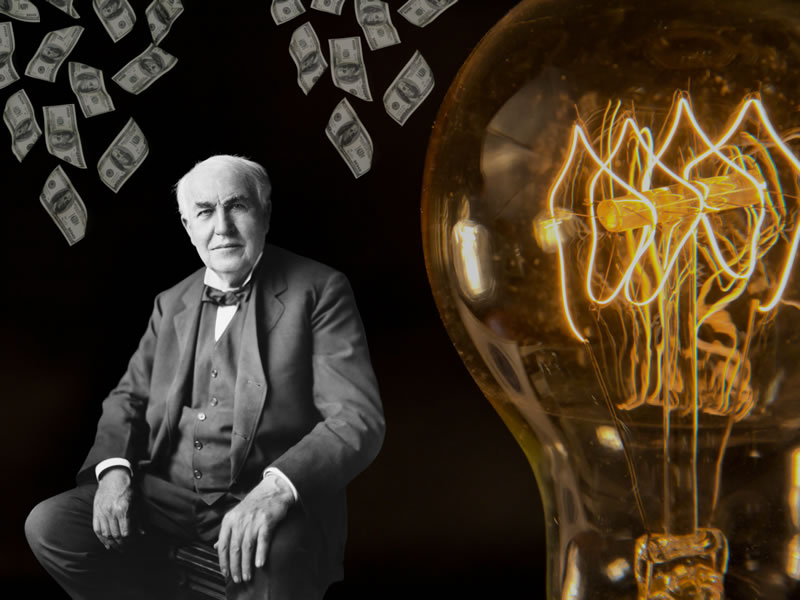
Maintaining a massive staff of chemists, machinists, and engineers cost a small fortune. Edison prioritized building bigger workshops, funding endless trials, and chasing new scientific breakthroughs over hoarding cash in a bank account.
2. Costly Business Failures
Not every invention Edison backed was a commercial success. In fact, he suffered several catastrophic financial losses on ventures that failed to capture the market:
- The Magnetic Ore Separation Venture: In the late 1880s and 1890s, Edison spent a decade and millions of dollars—a massive sum at the time—trying to mine low-grade iron ore using magnets. The project ultimately failed when rich iron ore discoveries were made in the Mesabi Range of Minnesota, rendering his entire enterprise obsolete.
- The Edison Portland Cement Company: While his cement company did eventually turn a profit, it consumed vast amounts of capital for years before paying off, and it never generated the kind of explosive wealth he expected.
- The Talking Doll: Introduced in 1890, Edison’s phonograph-infused dolls were fragile, expensive, and terrifying to children due to the scratchy audio. The product was pulled from shelves after just a few weeks, resulting in heavy financial losses.
3. Lacking the Killer Instinct of a Tycoon
Unlike his rival and occasional adversary, Nikola Tesla (who suffered a different kind of financial fate), Edison understood how to commercialize his work. He founded Edison General Electric, which eventually merged to become General Electric (GE). However, Edison relinquished control of the company relatively early on, losing his majority stakeholder position as outside investors and financiers took over.
Edison lacked the ruthless corporate maneuvering of titans like J.P. Morgan. While Morgan and other financiers built monolithic corporate empires that extracted maximum long-term profits, Edison was often content to sell off rights or move on to his next creative obsession.
The Legacy That Matters More Than Money
While the answer to whether Thomas Edison was a billionaire is a definitive 'no,' his true legacy cannot be measured in net worth alone. Edison revolutionized how humans live, work, and entertain themselves. His establishment of the industrial research laboratory fundamentally changed how modern products are developed, paving the way for corporate R&D centers like Bell Labs and Silicon Valley.
Edison may not have left behind a ten-figure inheritance, but his impact on the modern world is truly priceless. His financial reality proves that being one of history's most important innovators does not automatically guarantee a spot on the Forbes billionaire list—and that his true currency was human progress.