Washington Naval Conference APUSH Definition & Guide
When preparing for the AP U.S. History exam, understanding interwar foreign policy is crucial for mastering multiple-choice questions and essay prompts alike. A central event of this era is the 1921–1922 international summit held in the American capital. Knowing the exact washington naval conference apush definition helps students connect post-WWI isolationism, disarmament efforts, and rising tensions in the Pacific.

Washington Naval Conference APUSH Definition
In the context of APUSH, the Washington Naval Conference (also known as the Washington Arms Conference) was an international meeting called by U.S. Secretary of State Charles Evans Hughes from November 1921 to February 1922. The summit aimed to prevent an expensive naval arms race among the world's major military powers, limit the fortification of Pacific possessions, and stabilize geopolitical relationships in East Asia following World War I.
Rather than joining the newly formed League of Nations, Republican administrations in the 1920s pursued independent internationalism. The Washington Naval Conference stands as the prime example of this strategy: an attempt to achieve global security and peace through multilateral diplomacy, international agreements, and naval disarmament rather than collective security commitments.
Historical Context of the 1921 Summit
To fully grasp why this conference occurred, you must look at the global landscape immediately following World War I. Several distinct factors pushed the United States, Great Britain, and Japan toward the negotiating table:
- The Post-WWI Naval Race: The United States and Japan had both launched ambitious naval building programs during and immediately after World War I. Great Britain, exhausted financially by the war, struggled to maintain its traditional 'two-power standard' naval supremacy.
- Rising Tensions in East Asia: During the war, Japan expanded its influence in China (issuing the Twenty-One Demands) and seized German territories in the Pacific, alarming both American and British policymakers.
- Domestic Pressure for Tax Relief: American voters and politicians wanted to curb government spending. An unchecked naval arms race threatened to drain the federal budget through massive expenditures on dreadnoughts and battlecruisers.
Key Treaties Resulting from the Conference
The conference successfully produced three major treaties that reshaped international relations in the 1920s. APUSH exam questions frequently test students on the specific terms and signatories of these agreements.
1. The Five-Power Treaty
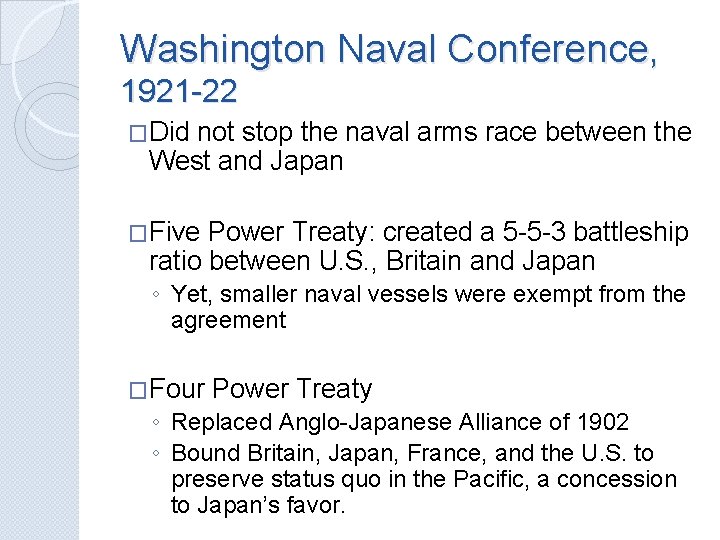
The Five-Power Treaty was the cornerstone of the conference, involving the United States, Great Britain, Japan, France, and Italy. It established a strict ratio for total capital ship tonnage and aircraft carrier tonnage:
- United States: 5
- Great Britain: 5
- Japan: 3
- France: 1.75
- Italy: 1.75
The treaty also included a provision that the U.S. and Great Britain would not build new fortifications or naval bases in their western Pacific possessions (such as the Philippines and Guam), which effectively gave Japan naval hegemony in its immediate home waters.
Video: What is Washington Naval Treaty?, Explain Washington Naval Treaty, Define Washington Naval Treaty
2. The Four-Power Treaty

Signed by the United States, Great Britain, France, and Japan, the Four-Power Treaty effectively terminated the Anglo-Japanese Alliance of 1902. The signatories agreed to respect each other's Pacific possessions and to consult with one another if a crisis threatened their interests in Asia. This treaty reduced the risk of an Anglo-American conflict and eased American anxieties about Japanese aggression.
3. The Nine-Power Treaty
This treaty reaffirmed the traditional U.S. 'Open Door Policy' regarding China. All nine participating nations—the Big Five plus China, Belgium, the Netherlands, and Portugal—agreed to respect Chinese territorial integrity and sovereignty, ensuring that all nations would have equal commercial access to Chinese markets.
Significance and Long-Term Limitations
For the APUSH exam, you should be able to analyze both the short-term successes and the long-term failures of these naval agreements. While the conference was widely praised in the 1920s as a triumph for peace, its limitations became glaringly obvious in the 1930s.
Successes
In the short term, the conference achieved its primary objectives. It successfully halted a costly naval arms race, eased tensions between the U.S. and Japan, and demonstrated that the United States could lead significant international diplomatic efforts without joining the League of Nations.
Limitations and Failures
Despite its ambitious scope, the Washington Naval Conference suffered from critical structural flaws:
- No Enforcement Mechanism: The treaties relied entirely on the voluntary good faith of the signatories. There were no military or economic penalties for violating the terms.
- Loopholes in Ship Design: The agreements strictly limited capital ships and aircraft carriers but ignored smaller vessels like cruisers, destroyers, and submarines, sparking a secondary arms race in those unmonitored categories.
- Rise of Militarism: When aggressive totalitarian regimes came to power in Japan, Germany, and Italy during the 1930s, these nations simply renounced the treaty restrictions. Japan officially withdrew from the naval agreements in 1934, setting the stage for renewed imperial expansion in Asia and the outbreak of World War II in the Pacific.
APUSH Exam Tips for the Washington Naval Conference
When this topic appears on the AP exam, it usually arises in multiple-choice questions regarding 1920s foreign policy, isolationism, or the roots of World War II. Keep these quick study tips in mind:
- Contrast with the League of Nations: Remember that Warren G. Harding's administration rejected the League of Nations but eagerly embraced unilateral arms control conferences.
- Connect to the 1930s: Use the failure of the Washington Naval Conference as evidence of the broader ineffectiveness of 1930s collective security and appeasement, showing how the desire for peace inadvertently emboldened aggressive nations.
- Key Figures: Associate Secretary of State Charles Evans Hughes with the bold opening proposal that stunned diplomats by demanding immediate cuts to existing naval fleets.