Watermelon Game Coolmath Games: Complete Guide
Few browser puzzles have captured the internet quite like the viral fruit-stacking craze. If you have spent any time playing the watermelon game coolmathgames version, you already know how deceptively easy it looks at first glance. You drop a couple of tiny cherries, merge them into a strawberry, and watch your score tick upward. Yet within five minutes, your container is cluttered with misplaced oranges and rogue apples, leaving you one awkward bounce away from an instant game over.

Known globally as Suika Game, this physics-driven puzzle found a natural home on Coolmath Games, offering players an accessible, no-install way to test their spatial reasoning. Reaching that coveted giant watermelon requires far more than dropping fruit at random. It demands patience, geometric foresight, and an understanding of how physics engines behave under pressure.
How the Watermelon Game Works
At its core, the game combines the dropping mechanics of Tetris with the merging logic of 2048. You drop a sequence of circular fruits into an open box. Whenever two identical fruits touch, they combine to produce the next largest fruit in the evolutionary hierarchy, granting points based on the size of the merge.
The twist lies in the physics. Unlike rigid grid puzzles, fruits are round, slick, and bouncy. Dropping a heavy fruit from high up pushes smaller fruits out of position, causing sudden chain reactions or wedging essential pieces where you cannot reach them. The match ends the moment any fruit crosses the dotted deadline at the top of the container and remains there for more than a second.
The Complete Fruit Evolution Order
To plan your drops effectively, you must memorize the evolution chain. Every fruit merges into a specific successor:
- Cherry: The smallest fruit; easily trapped beneath larger items.
- Strawberry: Slightly larger, handy for filling small gaps.
- Grape: Forms quickly from early cherry combinations.
- Dekopon (Tangerine): The transition point where fruit size begins impacting container floor space.
- Persimmon (Orange): Heavy enough to roll and displace smaller fruits.
- Apple: Takes up substantial horizontal room.
- Pear: Often creates awkward triangular gaps along the walls.
- Peach: A major hurdle; poor placement here often ruins a run.
- Pineapple: Massive; requires careful placement toward the container edges.
- Melon (Cantaloupe): The penultimate stage before the final prize.
- Watermelon: The ultimate goal, taking up roughly one-third of the screen.
How to Master the Watermelon Game Coolmath Games Edition
Getting past the peach stage is difficult for most players because they treat each drop as an isolated event. High-scoring runs require a consistent board layout and disciplined fruit management.
1. Build a Slope (The Descending Order Strategy)
The single most effective strategy in the game is maintaining a clear size gradient. Choose one corner—either the far left or far right—and designate it as your heavy zone. Your largest fruits (Pineapples, Melons) should stay anchored there.
From that corner, arrange smaller fruits in descending order toward the opposite wall. For example, your bottom layer might feature a Melon on the left, followed by a Peach, an Apple, and a Tangerine toward the right. This arrangement creates natural ramps. When you drop small fruits on the right side, they merge upward and roll leftward into their larger counterparts, sparking clean chain reactions.
2. Avoid the "Buried Fruit" Trap
The most common cause of early defeat is burying tiny fruits beneath massive ones. If a cherry or strawberry ends up pinned beneath an apple or pear, it creates empty, unusable space below while pushing everything above it closer to the failure line.
If you have an unavoidable small fruit that does not match anything nearby, drop it along the side wall opposite your heavy stack. Never drop small fruits directly on top of medium-sized gaps unless you have an immediate match queued up to clear them.
3. Leverage Fruit Physics and Momentum
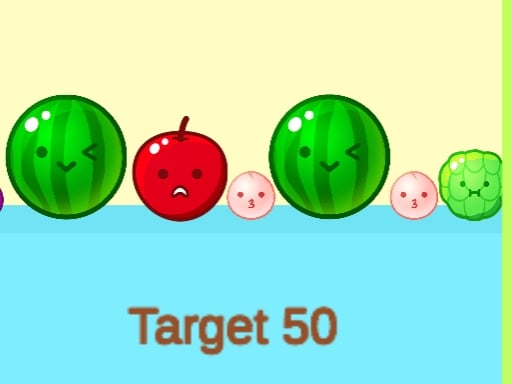
The fruits on Coolmath Games possess simulated mass and friction. You can exploit these properties to your advantage:
- Wedge Drops: Dropping a fruit into a narrow "V" between two others forces them apart, sometimes allowing a stuck fruit below to pop free.
- Rolling Assists: Dropping a round fruit onto a curved surface allows it to roll horizontally into a match that you could not reach via a direct vertical drop.
- Gentle Placement: Drop your pieces from as low as possible to prevent excessive bouncing, which often dislodges carefully placed stacks.
4. Pay Close Attention to the "Next" Preview
In the upper corner of the game screen, the game displays which fruit is coming up next. Always look at the queued item before committing your current drop. If you have an Apple currently, but a Cherry is next, plan where that Cherry will go before placing the Apple so you do not accidentally block an impending match.
Common Mistakes That Ruin High-Score Runs
Even seasoned players run into frustrating plateaus. If you find your runs stalling around 1,500 to 2,000 points, watch out for these subtle errors:
- Splitting identical large fruits: Having two Peaches separated by an immovable Pineapple makes merging them almost impossible. Keep identical large fruits side-by-side whenever feasible.
- Panic dropping during overflows: When the container nears the danger line, players often speed up their drops out of stress. Slow down. Carefully placed small merges near the top can trigger chain reactions that drop the entire stack by several inches.
- Overcrowding the center: Dropping everything down the middle creates a pyramid shape. Fruit rolling off a central peak is unpredictable and tends to wedge small fruits in both bottom corners simultaneously.
Why Play on Coolmath Games?
While the game originated as a Nintendo Switch title and spread across various mobile app stores, browser versions offer a distraction-free experience. The Coolmath Games platform runs smoothly in standard desktop and mobile browsers without requiring software downloads, system permissions, or aggressive microtransactions. The responsive controls make micro-adjusting your drop position simple using either arrow keys or mouse movement.
Frequently Asked Questions
What happens when two watermelons touch?
In most versions of the game, including the standard web adaptations, merging two full-sized watermelons clears both of them from the board completely. This awards a massive score bonus and frees up nearly half of the play area, allowing skilled players to continue their runs indefinitely.
Can you play the game on a mobile browser?
Yes. The Coolmath Games implementation is optimized for HTML5, meaning you can open the site on an iOS or Android browser and play using touch-and-drag inputs without installing an app.
Is the drop sequence purely random?
Not entirely. The game only gives you the first five fruits in the evolution chain (Cherry through Persimmon). You will never be handed an Apple, Pear, or larger fruit directly; every item beyond the fifth tier must be built through smart combinations.
Final Thoughts
Mastering this game is a test of restraint. Resist the urge to rush through drops, commit to your sloping layout, and keep your smallest fruits away from the floor of the box. With patience and good positioning, that first giant watermelon is only a matter of practice.


