What Is a Double Free? Causes, Risks, and Fixes
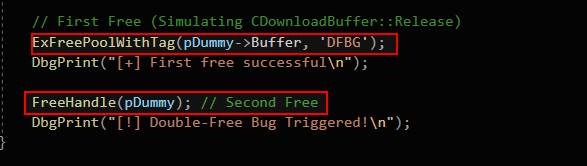
A double free error is one of the most common and dangerous memory management bugs found in systems programming languages like C and C++. It occurs when an application calls a deallocation function—such as free() in C or delete in C++—twice on the exact same heap memory address without an intervening allocation. While it might sound like an innocuous mistake, freeing memory twice can corrupt allocator state, crash applications, and create critical security vulnerabilities that attackers exploit for arbitrary code execution.

Understanding how double free bugs happen, how heap allocators respond to them, and how to defend your codebase against them is essential for writing resilient, secure native software.
What Causes a Double Free Vulnerability?
To understand the root cause of a double free, you must examine how dynamic memory management works. When you allocate memory using malloc(), the operating system's heap allocator reserves a chunk of memory and returns a pointer to the usable payload. Once your program finishes with that memory, it must explicitly release it back to the allocator via free().
A double free typically arises under three specific scenarios:
- Complex Error-Handling Paths: When a function encounters an error, it often attempts to clean up resources before exiting. If an error branch frees a pointer that was already freed earlier in the control flow (or that will be freed again in a central cleanup block), a double free occurs.
- Pointer Aliasing: If two different pointers point to the exact same heap allocation (shallow copying), one subsystem might release the memory while another subsystem still holds a reference. When the second subsystem finishes, it attempts to release the same address.
- Ambiguous Object Ownership: In C++ codebases without strict resource management models, multiple objects or classes may assume ownership over the same raw resource, leading to competing destructor calls that attempt deallocation.
A Minimal Vulnerable Example in C
Consider the following simplified C code demonstrating how easily this bug can slip past manual code review:
#include <stdlib.h>
#include <stdio.h>

void process_data(int condition) {
    char *buffer = (char *)malloc(128);
    if (!buffer) return;

    if (condition > 10) {
        // Early cleanup on specific condition
        free(buffer);
    }

    // ... more work done here ...

    // Unconditional cleanup at end of function
    free(buffer); // Double free if condition > 10
}
If condition exceeds 10, free(buffer) is executed twice. The pointer buffer remains unchanged in memory after the first free() call—it becomes a "dangling pointer." The runtime has no innate way to recognize that the raw address in buffer is no longer allocated unless defensive measures are in place.
How Double Free Bugs Corrupt Heap Memory
Heap allocators—such as GNU C Library's ptmalloc, Windows' Low Fragmentation Heap (LFH), or jemalloc—track free chunks of memory using internal data structures, often arranged as linked lists known as "freelists," "fastbins," or "tcaches."
When you free a chunk, the allocator inserts that chunk into an appropriate freelist so it can be quickly reused during future allocations. If a program frees the exact same chunk a second time:
- The allocator adds the identical memory chunk into its internal freelist twice.
- The freelist's pointers can form a circular reference (a cycle) pointing back to itself.
- Subsequent calls to
malloc()may return the exact same memory address to two completely unrelated callers.
Once two separate parts of an application share the same memory region under the assumption that they own it exclusively, data corruption is inevitable. One module overwrites the other's state, leading to inconsistent application states and sudden segmentation faults.
The Security Implications: From Crash to Arbitrary Code Execution
In security research, a double free is classified under CWE-415: Double Free. While modern allocators have introduced sanity checks to catch these conditions, sophisticated heap exploitation techniques (such as fastbin dup or tcache poisoning) have historically weaponized them.
By forcing the heap allocator to write forward and backward pointers into a memory block that the attacker can still write to, an exploit can overwrite arbitrary memory addresses. Common targets include:
- Function pointers in Global Offset Tables (GOT)
- C++ Virtual Method Tables (vtable pointers)
- Return addresses on the execution stack
If an attacker successfully redirects one of these pointers to shellcode or a Return-Oriented Programming (ROP) chain, the double free progresses from a denial-of-service crash to complete system compromise.
Modern Allocator Defenses and Their Limits
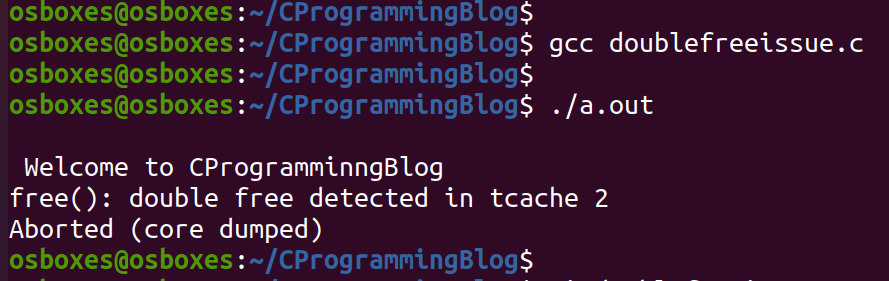
Modern runtimes do not sit idly by. The glibc allocator, for example, includes checks that detect immediate double frees:

*** Error in `./app': double free or corruption (fasttop): 0x00000000018f2010 ***
Aborted (core dumped)
Glibc checks the head of the free list. If you free pointer A, and immediately call free(A) again, the allocator notices that A is already at the top of the bin and terminates the program instantly. Similarly, modern versions of glibc implement cryptographic cookies or count-based validation in thread caches (tcache) to catch duplicates.
However, these checks are runtime heuristics, not guarantees. If the sequence is free(A), followed by free(B), followed by free(A), older allocators or those without deep traversal logic will not detect that A was already freed. Relying on the operating system or allocator to catch memory errors is not a defensive strategy.
Proven Methods to Prevent Double Free Errors
Preventing these bugs requires disciplined coding practices, modern language features, and automated verification tools.
1. The Pointer Nullification Idiom
In C, passing a NULL pointer to free() is guaranteed by the ISO C standard to be a safe no-op. You can leverage this rule by immediately resetting pointers to NULL upon deallocation:
free(buffer);
buffer = NULL;

// If called again later:
free(buffer); // Safe: free(NULL) does nothing
While effective for single-pointer variables, this does not eliminate the risk if another variable (an alias) still holds the original address.
2. Adopt RAII and Smart Pointers (C++)
If you are developing in C++, avoid raw memory operations (new and delete) entirely. Embrace Resource Acquisition Is Initialization (RAII) through modern smart pointers:
std::unique_ptr: Enforces exclusive ownership. The resource is destroyed precisely once when the smart pointer leaves its enclosing scope. Moving ownership transfers the pointer and sets the source to null automatically.std::shared_ptr: Implements atomic reference counting for shared ownership. The underlying memory is deallocated only when the final reference is destroyed.
3. Compile with AddressSanitizer (ASan)
AddressSanitizer is a powerful compiler-level tool available in GCC, Clang, and MSVC. It instruments memory allocations with "shadow memory" to detect invalid accesses and life-cycle errors instantly during testing.
Compile your binaries with the sanitization flag:
gcc -fsanitize=address -g main.c -o app
If a double free executes, ASan immediately halts the process and outputs a detailed crash trace displaying both the first and second deallocation call stacks, pinpointing the exact offending lines.
4. Use Static Analysis Tools
Do not wait for tests to catch heap issues. Static analyzers evaluate your code without executing it, tracing execution paths to detect control branches where resources are freed repeatedly. Tools like Clang Static Analyzer, Coverity, Cppcheck, and SonarQube can flag potential double frees before code is ever merged into production.
Conclusion
A double free is more than a simple crash—it is a fundamental breakdown of dynamic memory safety that leaves systems vulnerable to exploitation. By adopting modern language constructs like smart pointers, practicing strict ownership semantics, and integrating tools like AddressSanitizer and static analysis into your CI/CD pipeline, you can reliably eliminate this critical flaw from your software.