What Is a Perfumery? History, Craft, and Creation
When we admire a bottled fragrance, we rarely consider the physical or conceptual space from which it emerged. To truly understand what is a perfumery, you have to look beyond the retail bottle on a department store shelf and examine both the physical workshop where scents are born and the historic institutions that cultivate the art of olfactory design. At its core, a perfumery is a place where fragrances are formulated, compounded, and produced. Historically, it also refers to the business or house that creates and sells these aromatic concoctions.

The Anatomy of a Modern Perfumery
Modern perfumeries range from massive industrial production facilities run by multinational corporations to small, independent artisan studios. Regardless of scale, most traditional and professional perfumeries share a similar internal layout and workflow.
The Perfumer's Organ
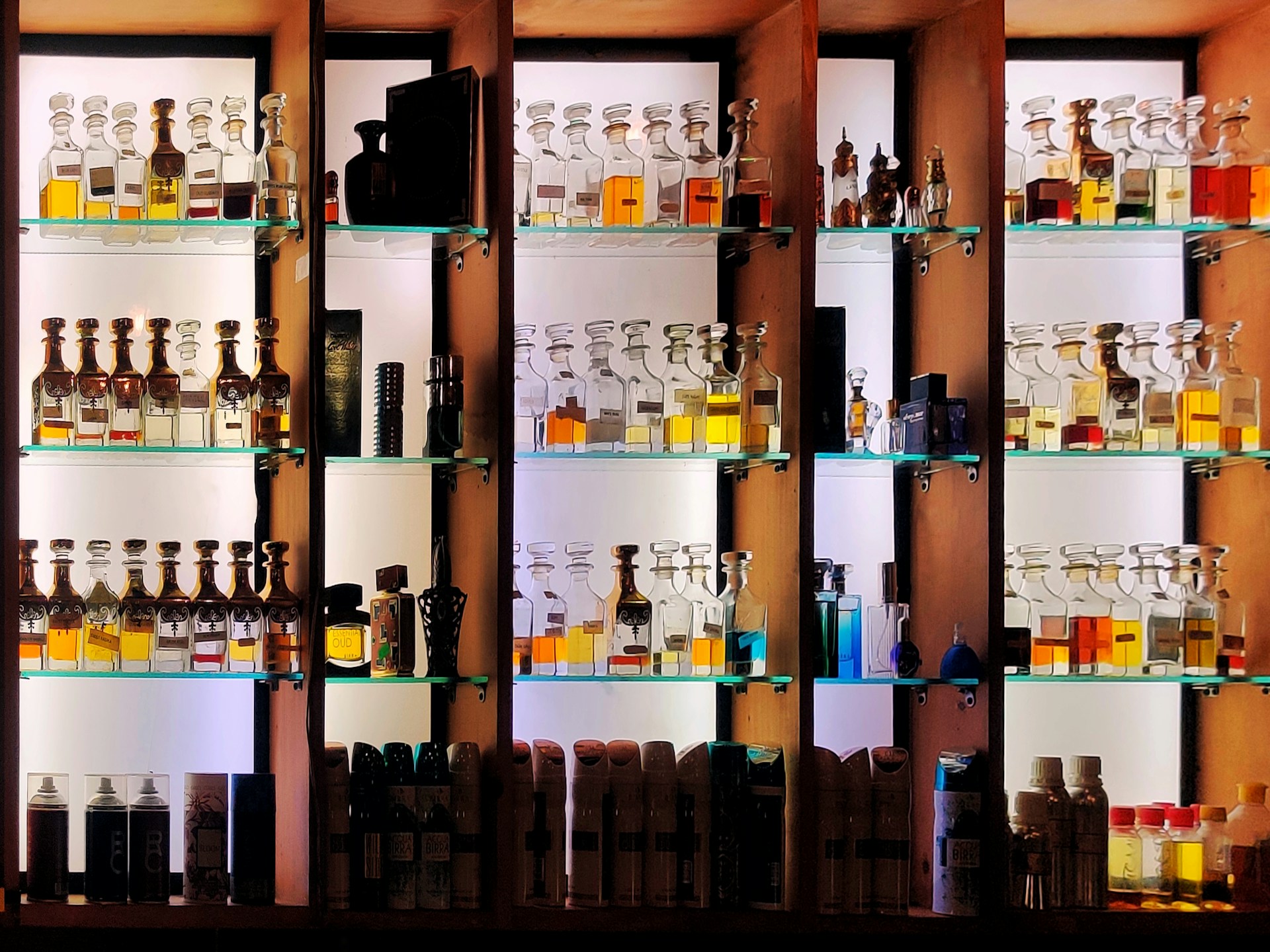
The centerpiece of any creative perfumery is the perfumer's organ. This is a specially designed workstation—historically shaped in a semicircle—that holds hundreds of essential oils, absolutes, and aroma chemicals in tiered shelving. The perfumer sits at the center of this station, akin to a church organist or a chemist at a lab bench, accessing a vast library of raw materials to build scent formulas.
The Laboratory and Weighing Room
Adjacent to the creative desk is the laboratory. Here, formulas developed on paper are physically mixed, measured to the milligram, and tested. Because precision is vital in scent creation, scales must be extraordinarily sensitive. Even a micro-drop of a powerful raw material like civet or synthetic ambergris can completely alter the balance of a blend.
The Aging Cellar
Once a fragrance concentrate is mixed, it cannot be bottled immediately. It requires maturation, or maceration. The compound is stored in stainless steel or glass vats in a temperature-controlled dark room—often referred to as the cellar—for weeks or months. During this time, the alcohol and aroma molecules bind together, smoothing out harsh edges and resulting in a harmonious final scent.
History and Evolution of the Perfumery
The concept of the perfumery has evolved dramatically over thousands of years, transitioning from ancient ritualistic practices to high-stakes modern commerce.
- Ancient Origins: The earliest precursors to the modern perfumery were found in ancient Mesopotamia, Egypt, and the Indus Valley, where priests and healers burned resins, gums, and woods for religious ceremonies.
- The Rise of Grasse: During the 16th and 17th centuries, the town of Grasse in the south of France emerged as the global capital of perfumery. Initially a hub for leather tanners who scented gloves to mask foul odors, Grasse quickly pivoted to cultivating jasmine, rose, and tuberose.
- The Industrial Revolution: The 19th century brought organic chemistry into the mix. Perfumeries began integrating synthetic ingredients like coumarin and vanillin, allowing for entirely new fragrance families that did not exist in nature.
Who Works Inside a Perfumery?
A successful perfumery relies on a diverse team of specialists, each playing a specific role in bringing a scent from concept to consumer.
The Master Perfumer (The "Nose")
The master perfumer is the creative director of the scent. Often possessing a memory bank of thousands of distinct smells, they spend years training under apprenticeship models. They conceptualize the fragrance, balance the top, heart, and base notes, and ensure the final product meets the brief provided by a brand.
Evaluators
Evaluators work closely with perfumers. While the perfumer focuses on the art and chemistry, the evaluator acts as a bridge to the commercial market. They provide objective feedback, guide the creative direction, and ensure the fragrance fits consumer trends and budget constraints.
Lab Technicians
Lab technicians handle the heavy lifting of physical compounding. They scale up small laboratory formulas into larger batches, manage inventory of raw materials, and oversee quality control to ensure consistency across production runs.
Types of Perfumeries Today
If you are looking to visit or purchase from a perfumery, you will generally encounter three distinct categories:
- Independent Artisan Perfumeries: Small-batch creators who formulate, bottle, and market their own lines. These are often found in cultural hubs like New York, Paris, or London, offering hyper-unique, narrative-driven scents.
- Boutique Custom Perfumeries: Interactive spaces where consumers can design their own bespoke perfumes with the guidance of a trained professional.
- Major Houses (Composition Houses): Massive global entities like Firmenich, Givaudan, and IFF. These companies create the formulas for major designer and celebrity fragrance brands behind the scenes.
Conclusion
A perfumery is much more than a shop that sells pleasant smells; it is a fascinating intersection of fine art, botany, organic chemistry, and sensory psychology. Whether operating out of a centuries-old stone building in Provence or a modern urban laboratory, a perfumery transforms invisible volatile molecules into deeply emotional human experiences.


