What Is Crude Rate? Definition, Formula, & Examples
Understanding What Is Crude Rate in Statistics

When analyzing public health data, demographics, or vital statistics, researchers rely on various metrics to make sense of large populations. If you have ever looked at birth, death, or disease statistics, you have likely encountered terms like "crude death rate" or "crude birth rate." But what is crude rate exactly, and how should you interpret it?
In simple terms, a crude rate is the actual observed rate of an event—such as a birth, death, or diagnosis of a disease—within a total population over a given time period, usually one calendar year. It is called "crude" because it is a raw, unadjusted figure. It takes the total number of events and divides it by the total population, without controlling for underlying variables like age, sex, or race.
While crude rates give a straightforward snapshot of overall frequency, they do not tell the whole story. Understanding their strengths and limitations is essential for anyone interpreting demographic or epidemiological data.
How to Calculate a Crude Rate
The calculation of a crude rate is mathematically straightforward. It requires only two primary pieces of data: the total number of events that occurred and the total size of the population at risk during that same period.
The Standard Formula
To find the crude rate, use the following formula:
Crude Rate = (Number of Events / Total Population) × k
Where:
- Number of Events: The total count of the specific occurrence (e.g., deaths, births, or disease diagnoses) during a specific time frame, usually a year.
- Total Population: The average or mid-year total population of the area being studied.
- k (Multiplier): A constant, such as 1,000, 10,000, or 100,000, used to convert the resulting decimal into a readable whole number. For instance, death rates are typically expressed per 1,000 or 100,000 people.
A Practical Calculation Example
Imagine a small town with a total population of 50,000 people. Over the course of a single year, the local health department records 500 deaths from all causes combined. To find the crude death rate per 1,000 residents:
- Divide the number of deaths by the total population:
500 / 50,000 = 0.01 - Multiply the result by the constant (1,000):
0.01 × 1,000 = 10
The crude death rate for this town is 10 deaths per 1,000 residents per year.
Video: Crude Birth Rate
Common Types of Crude Rates

Demographers and public health professionals utilize several standard crude metrics to monitor population changes and health trends. The most common include:
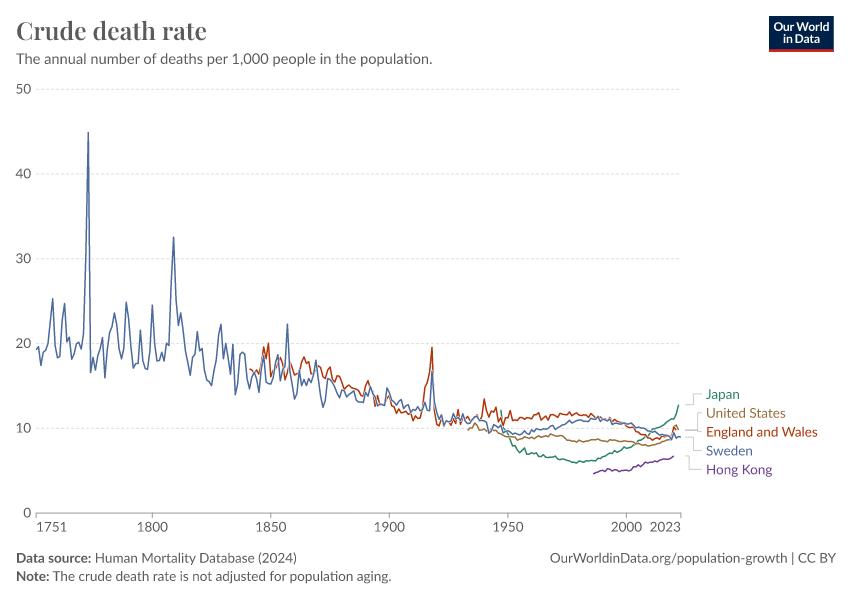
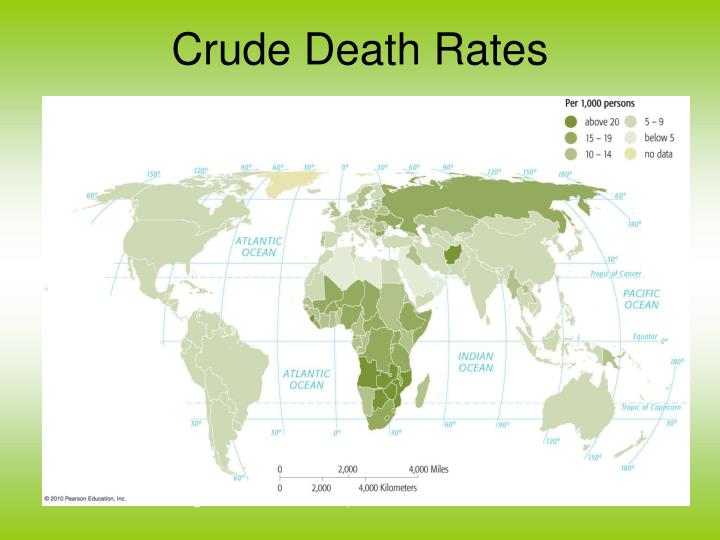
- Crude Death (Mortality) Rate: The total number of deaths from all causes per 1,000 or 100,000 population in a given year.
- Crude Birth (Natality) Rate: The total number of live births per 1,000 population in a given year.
- Crude Marriage Rate: The total number of legal marriages per 1,000 population over a specific period.
- Crude Divorce Rate: The total number of legally dissolved marriages per 1,000 population.
Each of these metrics provides a high-level overview of demographic activity within a country, state, or municipality.
Crude Rates vs. Age-Adjusted Rates
While crude rates are easy to compute and understand, they have a major limitation: they can be heavily skewed by the demographic composition of a population, particularly age.
The Problem of Confounding Variables
Consider two different communities:
- Community A is a retirement village in Florida, populated primarily by senior citizens aged 65 and older.
- Community B is a vibrant university town populated mostly by young adults aged 18 to 24.
If you look only at the crude death rate, Community A will have a drastically higher mortality rate than Community B. Does this mean Community A has inferior healthcare, or that it is a dangerous place to live? Not necessarily. It simply means that older adults are naturally at a higher stage of life where mortality is statistically more frequent.
When to Use Adjusted Rates
Because crude rates do not account for age distribution, researchers use age-adjusted rates (or standardized rates) when comparing health outcomes across different populations or across time periods where the population's age structure has shifted. Age-adjustment mathematically removes the effect of age differences, allowing for a fair, apples-to-apples comparison.
Why Are Crude Rates Still Useful?
Despite their limitations regarding comparisons, crude rates remain vital tools in statistics for several reasons:
- Resource Allocation: Government agencies and local municipalities need crude numbers to understand the actual absolute burden on infrastructure. For example, a hospital system needs to know the total number of births or deaths expected in a region—regardless of age—to plan staffing, bed capacity, and resource distribution.
- Simplicity and Transparency: Because they rely strictly on raw counts and total population sizes, crude rates are easy to calculate, verify, and communicate to the general public without complex statistical modeling.
- Baseline Tracking: They offer a quick, macro-level indicator of overall population growth, decline, or general health shifts from year to year within the same geographic area.
Conclusion
Knowing what is crude rate helps you critically evaluate demographic data and public health reports. While a crude rate provides a straightforward, real-world count of events like births or deaths relative to total population size, it must be interpreted with caution. Because these raw metrics do not control for demographic factors like age or sex, they are best used for resource planning and internal tracking rather than direct comparisons between fundamentally different communities.