What Is Kria? AMD Adaptive SoCs Explained
When developing modern edge AI and embedded vision applications, engineers often face a difficult trade-off. They need the high performance and low latency of hardware acceleration, but they also want the rapid software development cycles typical of traditional microprocessors. This is where Kria adaptive system-on-modules (SOMs) come into play, bridging the gap between flexible hardware and accessible software design.

Developed by AMD (incorporating Xilinx technology), the Kria portfolio is designed to simplify deployment for developers who may not have deep expertise in FPGA (Field Programmable Gate Array) design. By pre-building the complex hardware layers, these modules allow innovators to focus entirely on application development, significantly shortening time-to-market.
Understanding Kria Adaptive SoCs
At its core, a Kria module is a production-ready small-form-factor compute board. Unlike traditional chip-level design where you must lay out your own power management, memory interfaces, and high-speed transceivers, a Kria SOM integrates all these critical components into a single ruggedized package.
The architecture relies on AMD Zynq UltraScale+ MPSoC technology. This combines a processing system—typically featuring multi-core ARM Cortex application and real-time processors—with programmable logic. The programmable logic fabric is what gives the platform its adaptive nature, allowing developers to configure hardware accelerators specifically tailored to their algorithms, whether for computer vision, robotics, or industrial automation.
Key Architectural Features
- Integrated Memory: High-speed LPDDR4 memory is built directly onto the module, ensuring high bandwidth for data-intensive machine learning workloads.
- Advanced Security: Secure boot, configuration, and key management features protect intellectual property at the edge.
- Standardized Connectors: High-density connectors interface the SOM with application-specific carrier boards, separating the processing complex from the I/O.
- Thermal Solutions: Integrated heat spreaders and custom cooling options ensure reliable operation in demanding industrial environments.
Kria Portfolio Overview
The product family includes targeted solutions tailored for different performance tiers and application domains. Two standout members of the lineup are the KV260 Vision AI Starter Kit and the KR260 Robotics Starter Kit.
Kria KV260 Vision AI Starter Kit
The KV260 is tailored specifically for vision applications such as smart cameras, retail analytics, machine vision, and medical imaging. One of its most appealing aspects is that it does not require any prior FPGA knowledge. Developers can unpack the kit, plug in a camera, and run accelerated AI inference pipelines within minutes.
The starter kit includes the KV260 SOM mounted on a carrier board with standard interfaces like HDMI, USB, Gigabit Ethernet, and a Raspberry Pi camera connector. This makes it an ideal evaluation and prototyping platform before transitioning to custom carrier boards for production.
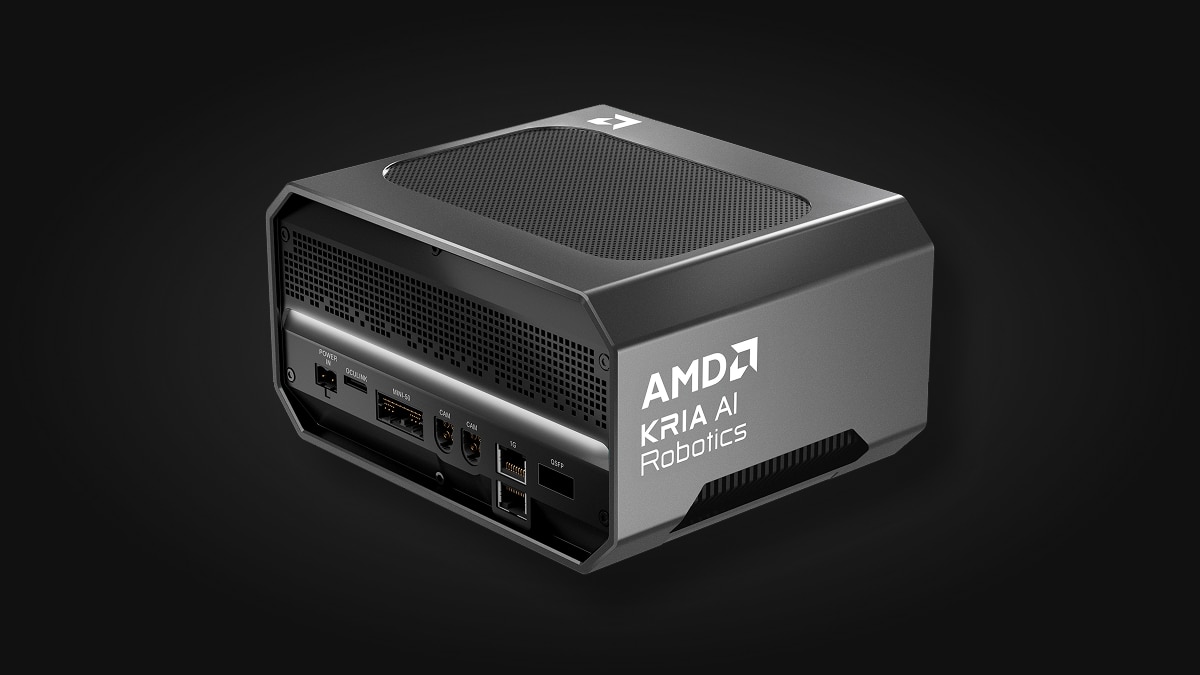
Kria KR260 Robotics Starter Kit
Video: Eritrean music kria
Building upon the vision-focused model, the KR260 is engineered for industrial automation, robotics, and machine control. It adds native industrial interfaces such as dual-port Gigabit Ethernet with Time-Sensitive Networking (TSN) support, SFP+ enclosures for high-speed networking, and an Arduino-compatible header for easy sensor integration.

Crucially, the KR260 natively supports ROS 2 (Robot Operating System), which has become the de facto standard framework for roboticists worldwide. Hardware acceleration is used to offload heavy computational tasks from the CPU, resulting in faster loop rates and lower deterministic latency.
Software Ecosystem and App Store
Hardware is only half the battle in embedded design. To make the Kria platform truly accessible, AMD developed a robust software stack centered around containerization and pre-built applications.
App Store Acceleration
Instead of compiling custom bitstreams from scratch, developers can browse an online app store containing pre-built accelerated applications. These applications package the underlying hardware accelerators (overlays) together with the software stack and runtime environments into deployable containers.
- Select an application from the app catalog (e.g., smart spatial tracking, face detection, or object classification).
- Download and install the container onto the target board.
- Feed your video stream or sensor data into the pipeline and start executing.
This containerized approach allows developers to dynamically swap hardware accelerators on the fly simply by loading a different application container, mimicking the flexibility of software updates on a microcontroller.
Benefits for Edge AI and Industrial IoT
Deploying artificial intelligence at the edge introduces unique challenges, including strict power budgets, harsh physical environments, and the need for real-time responsiveness. Kria modules address these challenges directly.
Because processing happens locally on the device rather than in the cloud, applications benefit from zero cloud latency, lower bandwidth costs, and enhanced data privacy. Furthermore, the ability to update both hardware and software remotely means systems deployed in the field can be continuously improved over time without physical intervention.
Conclusion
The Kria adaptive system-on-module ecosystem represents a significant shift in how embedded systems and edge AI devices are built. By abstracting away the underlying complexity of FPGA design and offering a rich, containerized software framework, AMD has made high-performance hardware acceleration accessible to mainstream software developers and robotics engineers alike.
Whether you are prototyping a smart vision system with the KV260 or deploying an autonomous mobile robot with the KR260, these modules provide a scalable path from initial concept to volume production.