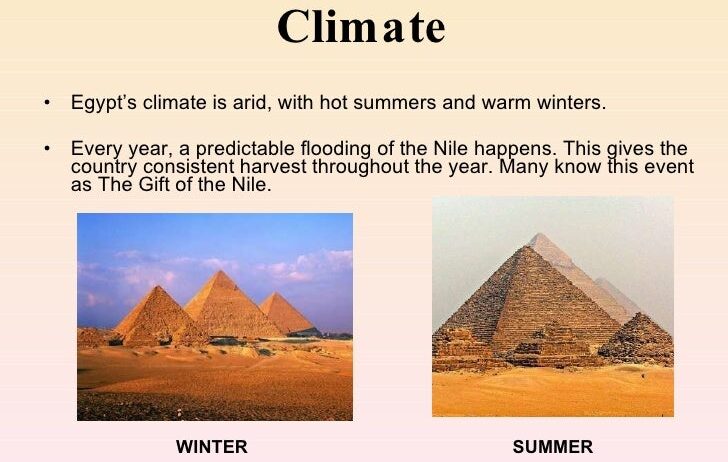
What Is the Climate of Ancient Egypt?
Introduction to Ancient Egyptian Weather

When people picture ancient Egypt, they typically imagine a scorching, sun-bleached desert punctuated only by monumental pyramids and the winding, life-giving ribbon of the Nile River. Popular culture paints a picture of a civilization that barely changed across three millennia, locked in a permanent, arid heatwave. But what is the climate of ancient Egypt in historical reality? Was it always as dry as it is today, and how did ancient populations adapt to their atmospheric environment?
Paleoclimatological research reveals that while ancient Egypt was predominantly dry and sunny, its environment was dynamic. Subtle shifts in global weather patterns, localized river dynamics, and seasonal variations dictated everything from agricultural calendars to religious beliefs. Understanding this ancient climate requires looking past modern stereotypes to examine how the geography of North Africa interacted with the atmosphere thousands of years ago.
The Sahara: A Gradual Drying Process
One of the biggest misconceptions about ancient Egypt is that the Sahara Desert was already a fully formed wasteland when the first farmers settled along the Nile. In reality, the regional climate underwent a dramatic transformation during the Holocene epoch.
The African Humid Period
Between roughly 9,000 and 6,000 BCE, North Africa experienced what geologists call the African Humid Period (or 'Green Sahara'). During this era, monsoonal rains pushed much further north than they do today. The land that now constitutes the arid Sahara was a savannah-like landscape dotted with grasslands, shrubs, and seasonal lakes.
As the Earth's orbital tilt slowly shifted, this monsoon belt migrated southward. By the time the Early Dynastic Period of Egypt began around 3100 BCE, the Green Sahara was largely gone, replaced by hyper-arid desert conditions. However, the legacy of this wetter era remained in the form of deep groundwater aquifers and occasional flash floods in eastern desert wadis (dry riverbeds).
Seasons and Temperature in the Nile Valley
Rather than dividing the year into the standard four seasons recognized in temperate zones, the ancient Egyptians split their annual calendar into three distinct agricultural seasons dictated by the behavior of the Nile River and local weather patterns:
- Akhet (The Inundation): Lasting roughly from June to September, this was the flood season. While it didn't rain heavily in Egypt itself, torrential summer monsoons in the highlands of modern-day Ethiopia and East Africa fed the Blue Nile, causing the river to burst its banks across Egypt.
- Peret (The Growing Season): Running from October to February, this period saw the floodwaters recede. Temperatures dropped to comfortable levels, and farmers plowed and planted seeds in the rich, dark silt left behind by the inundation.
- Shemu (The Harvest / Drought Season): Spanning from March to May, this was the hottest and driest time of year. Temperatures soared, crops were harvested, and the relentless sun baked the landscape until the cycle began anew.
Water Systems and Rainfall

Rainfall in ancient Egypt was exceptionally rare, much as it is in modern Egypt today. Most of the country receives less than an inch of rain annually. Occasional winter storms brought brief, sharp showers to the Mediterranean coast (such as Alexandria), but the interior Nile Valley remained virtually rain-free.
Instead of relying on rainfall for agriculture, ancient Egyptians depended entirely on the annual Nile flood. This reliance made society uniquely vulnerable to climate fluctuations. If the monsoon rains in East Africa failed, the Nile did not flood adequately, leading to widespread famine and political instability. Conversely, an excessively high flood could wash away villages and storage facilities.
Winds and Microclimates
Wind played a massive role in daily life and transportation in ancient Egypt. The prevailing winds blew steadily from the north to the south, while the Nile River flowed from south to north. This unique geographical quirk made navigation exceptionally easy: sailors could raise their sails to travel upstream against the current, and simply take down their sails and drift downstream with the current.
However, the climate also brought hazards:
- The Khamaseen: A hot, dust-laden wind that typically blows from the southern deserts during the spring season (Shemu). It can reduce visibility to nearly zero and cause sudden, oppressive spikes in temperature.
- Microclimates: The narrow strip of green agricultural land bordering the Nile created a distinct humid microclimate that contrasted sharply with the bone-dry desert plateaus just a few miles away.
How Climate Preserved Ancient Artifacts
The hyper-arid climate of ancient Egypt—characterized by intense heat, minimal rainfall, and low humidity—was arguably the single greatest factor in preserving the physical remains of their civilization. Organic materials that would have rotted away within decades in European or Asian climates survived millennia in Egyptian tombs.
Papyrus scrolls, wooden furniture, textiles, and even food offerings placed in tombs remained intact because the bone-dry air prevented mold growth and bacterial decay. Furthermore, natural mummification occurred in early predynastic shallow graves, where hot desert sand dehydrated bodies rapidly before decomposition could set in.
Conclusion
What is the climate of ancient Egypt? It was a harsh, sun-drenched, and overwhelmingly arid environment balanced by the miraculous, life-sustaining pulse of the Nile River. While the climate forced ancient Egyptians to develop sophisticated water management and agricultural techniques, it also gifted modern historians with an unprecedentedly well-preserved window into the past.