Why My Lawn Mower Won't Stay Running: Easy Fixes
Few weekend chores are more frustrating than pulling the recoil starter, hearing the engine roar to life, and watching it abruptly sputter out. When you find yourself standing in tall grass thinking, "my lawn mower won't stay running," the good news is that small four-stroke engines are mechanically straightforward. In most cases, stalling occurs because of an imbalance in one of three fundamental areas: fuel, air, or spark.

Before buying expensive replacement parts or hauling your machine to a repair shop, use this troubleshooting guide to isolate the issue, fix it with basic tools, and get back to cutting your lawn.
Why My Lawn Mower Won't Stay Running: 6 Common Causes
When an engine starts, it proves that the piston, valves, and initial ignition timing are functioning. If it dies shortly afterward, something is interrupting continuous combustion. Here are the most frequent culprits behind an engine that refuses to stay running.
1. Old or Degraded Fuel
Modern pump gasoline contains up to 10% or 15% ethanol. Ethanol is hygroscopic, meaning it absorbs moisture directly from the atmosphere. Within 30 days, untreated pump gas begins to oxidize and degrade. As the volatile compounds evaporate, the fuel leaves behind a sticky varnish that restricts internal passages. Even worse, water-separated fuel sitting at the bottom of the tank will enter the combustion chamber and extinguish the flame.
2. A Clogged Carburetor Jet
The carburetor meters fuel and mixes it with incoming air before sending it to the cylinder. Inside, tiny brass passages called jets regulate this flow. When old fuel sits over winter, it coats these pinhole-sized jets in sticky lacquer. If the pilot jet or main jet is partially obstructed, the engine may start on the heavy shot of fuel provided by the primer bulb or choke, but it will immediately starve and stall once it relies on the steady draw through the carburetor.
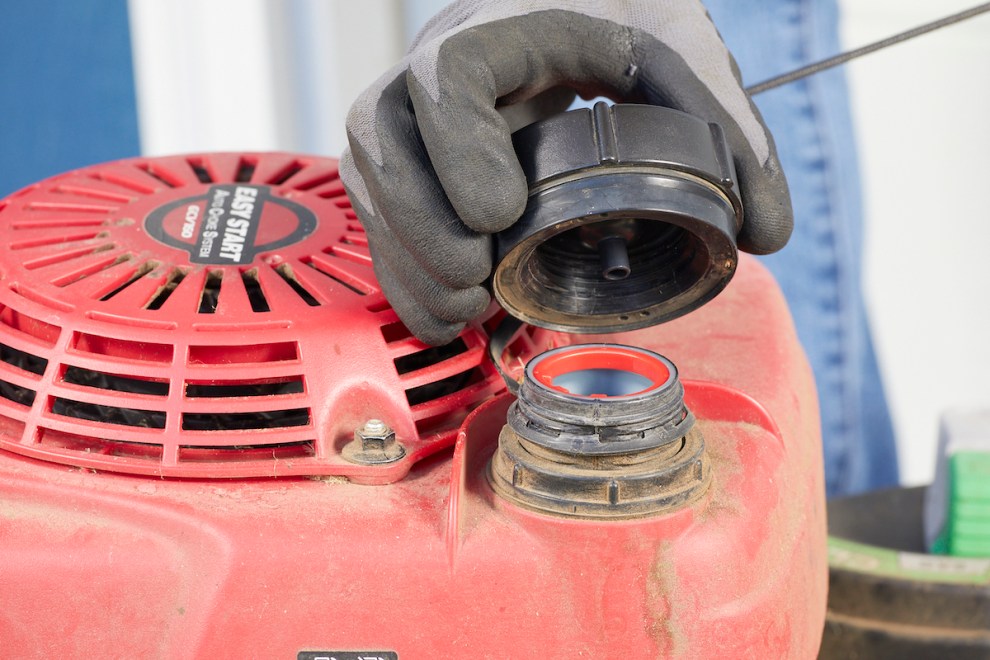
3. A Blocked Fuel Tank Cap Vent
Fuel cannot leave the gas tank unless air enters to replace it. Lawn mower gas caps feature tiny integrated vent holes or check valves to allow atmospheric air into the tank. If dirt, dried clippings, or residue clogs this vent, the fuel pump or gravity-feed system creates a vacuum inside the tank as gas drains out. Once the vacuum is strong enough, fuel stops flowing into the carburetor bowl, and the engine starves.
4. Clogged or Oil-Soaked Air Filter
An engine needs roughly 14.7 parts of air for every 1 part of fuel to achieve complete combustion. If your pleated paper or foam air filter is caked with dust, grass mulch, or engine oil (which often happens if the mower was tipped on its side incorrectly), air intake drops drastically. The engine pulls too much fuel relative to air, creating a rich condition that fouls the spark plug and chokes out the flame.
5. A Failing Ignition Coil or Fouled Spark Plug
Spark plugs endure immense heat and carbon buildup. A plug with heavy black deposits or an improper gap cannot reliably maintain an arc under operating temperatures. Similarly, an ignition coil (armature) can develop internal hairline cracks in its copper windings. As the engine runs for several minutes, the coil heats up, causes the wire inside to expand, breaks the electrical circuit, and cuts spark completely until the engine cools down again.
6. Pinched or Blocked Fuel Line
Inline fuel filters and rubber fuel hoses can deteriorate. The inner lining of older fuel lines can collapse internally—appearing normal on the outside while restricting fuel flow to a mere trickle. A partially clogged inline fuel filter will allow enough gas into the carburetor bowl to idle for 20 seconds, but as soon as the bowl empties, the engine dies.
How to Diagnose the Stalling by Symptom Timing
How long your mower runs before dying offers clear clues about where the problem lies. Match your mower's behavior to the timeline below:
- Runs for 2 to 5 seconds, then dies: Classic carburetor or stale fuel symptom. The engine is burning only the fuel supplied by priming or choke, then starving when normal metering should take over.
- Runs for 1 to 3 minutes, then sputters out: Likely a restricted fuel line, clogged inline fuel filter, or stuck carburetor float needle that cannot fill the bowl quickly enough to match fuel consumption.
- Runs for 5 to 15 minutes, then abruptly cuts off: Check the fuel cap vent first. If opening the gas cap produces a hiss of air and the mower immediately restarts, the cap vent is plugged. If not, suspect a thermal failure in the ignition coil.
- Stalls only when you engage the blades or hit tall grass: Points to an engine starved for power due to a dirty air filter, partially restricted main jet, dull mower blade causing excessive drag, or a malfunctioning governor spring.
Step-by-Step Fixes to Keep Your Mower Running
Always disconnect the spark plug wire before performing any maintenance on your mower to prevent accidental starting.
Step 1: Test and Clear the Fuel Cap Vent
The quickest test in small engine diagnostics takes thirty seconds. Run the mower until it begins to stumble, then quickly shut it off, loosen the fuel cap half a turn, and restart it. If the engine continues running smoothly with the cap loose, replace the gas cap or clean the vent with compressed air.
Step 2: Inspect the Air Filter
Remove the air cleaner cover. If your mower uses a paper element, hold it up toward the sun. If you cannot see light passing through the pleats, tap it gently on a hard surface to dislodge loose debris. If it remains discolored or soaked with oil, replace it. If your mower uses a foam filter, wash it in warm, soapy water, let it dry completely, and saturate it lightly with clean engine oil, squeezing out any excess.
Step 3: Flush the Fuel and Check Lines
If fuel has been in the mower for longer than two months without stabilizer, use a siphon pump to drain the tank completely into an approved container. Inspect the fuel line running from the tank to the carburetor. Disconnect the line at the carburetor inlet and aim it into a catch cup: fuel should flow in a steady, unbroken stream. If it drips slowly, replace the fuel line and the inline filter.
Step 4: Clean the Carburetor Float Bowl and Jets
You often do not need to remove the entire carburetor to restore fuel flow. On many Briggs & Stratton, Kohler, and Honda engines, you can clean the primary jet directly:
- Clamp the fuel line shut with a hose clamp.
- Place a rag under the carburetor and remove the bolt at the bottom of the float bowl (this bolt is often the main jet itself).
- Examine the bolt holes. You will see a tiny hole drilled down the center and sideways through the threads.
- Spray carburetor cleaner through the bolt and push a thin copper wire (such as a strand from an electrical wire) through the holes to clear dried debris. Avoid steel wire or drill bits, which can enlarge the brass orifice.
- Drop the bowl, clean out any sediment with carburetor cleaner, confirm the float moves up and down freely, and reinstall the bowl with a fresh gasket.
Step 5: Check the Spark Plug
Remove the spark plug using a deep socket. Inspect the electrode at the tip. If it is coated with wet, black soot or white crusty deposits, clean it with a wire brush or replace it—spark plugs are inexpensive and eliminate an unnecessary variable. Use a feeler gauge to verify the electrode gap matches the manufacturer's specification (typically 0.030 inches for most walk-behind mowers).
Preventive Measures for Trouble-Free Mowing
Fixing your mower is only half the battle; preventing recurring fuel issues saves hours of future frustration. Adopt these simple fuel-management practices:
- Use ethanol-free gas: If available in your area, buy ethanol-free (rec-90) fuel for all small engines. It does not attract water and has a significantly longer shelf life.
- Add stabilizer immediately: Treat your gas container with fuel stabilizer at the gas pump on the day you fill it, rather than waiting until the fuel sits in your mower.
- Run the carburetor dry before winter: Turn off the fuel valve and let the mower run until it dies before winter storage, or siphon the tank dry. Never leave untreated ethanol fuel sitting in the carburetor over winter.
By methodically testing your fuel supply, cleaning air passages, and ensuring clear fuel delivery, you can solve nearly all stalling issues in under an hour without costly service bills.


